Information About ‘Flora & Fauna’ in The Philippines
Saturday, May 13th, 2017
|
|
|
Images courtesy: John Smart |
If you visited Puerto Galera in 1981, it would not have been uncommon to see turtles swimming along the shallow waters off the beaches and in the bays. The turtles would feed on the sponges and swathes of sea grass. Turtles would lay their eggs along the almost deserted beaches, especially along the peninsular beaches (from Coco Beach to Sabang Beach) and their young would stumble back into the water upon hatching, to commence their years of cruising the oceans.
Posted in eco-tourism, Flora & Fauna, Water Sports | Tags: green sea turtle, hawksbill turtle, Puerto galera, sea turtles | No Comments »
Wednesday, March 30th, 2016
|
|
|
Image courtesy: John Smart |
A sailing cruise aboard S/Y Naya
Fancy a sailing cruise in the Philippines? We will have to be friends first . . . in return you will enjoy some of the prettiest sailing cruise destinations in the Philippines and chance to meet some of the ocean’s most astounding creatures.
We set sail from Laiya, Batangas, with the intent of starting our five day sailing cruise by crossing to the island of Marinduque; to be specific, to the Tres Reyes island chain, off the southwest of Marinduque Island. However, the wind did not favor this plan and so, fairly early, we changed course for the volcano island of Sibale (also known as Conception and Maestre de Campo, depending on the map you use).
Posted in Adventure Sports, eco-tourism, Flora & Fauna, Sailing Yachting, Travel Services, Water Sports | Tags: Banton Island, Boracay, Romblon, Sailing, Sibale, Tablas Island, Yacht Charter | No Comments »
Saturday, September 6th, 2014
|
|
|
Photo courtesy: John Smart |
“Biodiversity is important to Man” I stated, during a discussion with business acquaintances last week. I was shocked that more than half the group asked, “Why?”
Here are the 3 reasons why biodiversity is important to Man.
Posted in Birdwatching, eco-tourism, Flora & Fauna, Kayaking Canoeing, Renewable Energy | Tags: animals, biodiversity, birds, habitat loss, Man, plants, survival | No Comments »
Thursday, August 21st, 2014
|
|
|
Photo courtesy: Juliet Solar |
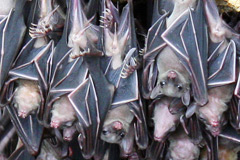
On a beach on the island of Sibale, about 15 miles off the coast of Mindoro, when the glow of the departed sun is still lingering in the heavens, a large fruit bat may flap into the arms of the talisay tree that has given me shade throughout the day. It will climb in ungainly fashion along the limb of the tree towards a small clumps of fruits near the extremity. After maybe 30 minutes it will take flight and depart towards another stand of trees on the headland, about a mile distant, its darkened form a momentary obscurer across the star studded heavens. Could this be the killer? . . . the carrier of ebola virus that is currently causing untold panic and bizarre acts of civil and state sponsored violence, pitting neighbor against neighbor in West Africa?
Posted in Flora & Fauna | Tags: ebola, Fruit Bats, killer, victim, West Africa | No Comments »
Monday, January 31st, 2011
|
|
|
Image courtesy MyCam-Asia.tv |
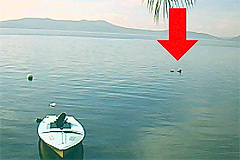
Someone obviously believes that the deep and dark waters of Taal Lake are somehow similar to those of the famed Loch Ness and has taken the trouble to view endless hours of images from the IP camera (webcam) that is attached to the second coconut tree to the left of the Taal Lake Yacht Club lake-shore bar. They have captured a sequence of images that clearly show something that suddenly appears about 100 feet from the camera and then slowly proceeds across the screen, ducking and diving, before disappearing from view some minutes later. The video is now on YouTube (see bottom of this article for the link).
Certainly Taal Lake holds many of Nature's hidden treasures and some yet to be described creatures, trapped there after the six-month long volcanic eruption of 1754, but a monster like Nessie? It seems too incredible. However, as we have seen in other parts of the World, since the widespread use of cameras that do nothing but sit there and take images all day, where people are not so frequent, sometimes the incredible can be witnessed.
Posted in Flora & Fauna, Trivia, Videos | Tags: Loch Ness Monster, Philippines, Taal Lake, Taal Volcano, Tawilis, Video, Yacht Club, YouTube | No Comments »
Wednesday, December 8th, 2010
|
|
|
Image courtesy The Bat Camp |
Monfort Bat Cave's, Bat Camp 2011. This Bat Camp event will educate and inform people of the unique role that bats play in our everyday lives and why it is important to protect & preserve bat habitats around the country. The Monfort Bat Cave was chosen as the venue for the start of Philippine Year Of The Bat activities because it is recognized as the location of the largest colony of fruit bats in the World (see “Samal Island Fruit Bats Into Guinness World Records”).
The Monfort Bat Cave Conservation Foundation (MBCCFI) in conjunction with Philippine Bat Conservation (PBCI) will organize a series of activities including research, exhibits, lectures, interactive learning experiences for kids plus special bat-emergence viewing and a donor's day.
Posted in Caving Spelunking, Flora & Fauna | Tags: 2011, Bat CampYear Of The Bat, cave assessments, cave bats, cave research, Fruit Bats, Monfort Bat Cave, Philippines, Samal Island | No Comments »
Sunday, October 17th, 2010
|
|
|
Image courtesy John Smart |
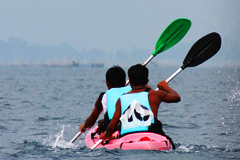
The Philippine Kayaking Series continues with the first ever 32km Kayak crossing from Talisay to Pansipit River. This 32km kayak marathon event is part of a kayaking event for the protection of Taal watersheds, with Pusod, an NGO, committed to implement the Taal Volcano Protected Landscape.
For decades Taal Lake has been used and abused by local (and not so local) communities, to its detriment. Most of the abuse has been in the form of overfishing and exploitation, with the burgeoning deployment of fish cages for aquaculture-profit. With the ever increasing scarring of the mountainsides and valleys for housing projects (95% of which are for second homes), the removal of the forests and the pollution of the rivers and streams that feed the Taal Lake, are now Taal Lake's greatest enemies.
Posted in Adventure Sports, Flora & Fauna, Kayaking Canoeing, Water Sports | Tags: Bull Sharks, kayak, Kayaking, Philippines, Taal Lake, Taal Volcano, Tawilis | No Comments »
Wednesday, June 30th, 2010
|
|
Image/Video courtesy Martyn Willes |
Every day at sundown, when all God fearing citizens of the World are contemplating retirement to the safety of varietous shelters, the 1.8 million inhabitants of the Monfort Bat Cave are just waking to the opportunity of emergence into a night-long feast on their favourite prey: nectar and fruit . . . lots of nectar and fruit. The Monfort Bat Cave on Samal Island is home to the largest colony of fruit bats in the world (see previous World record article).
On one not-so-moonlit evening in June the GetWet camera crew braved torrential rain to bring you this 2-minute video-segment of the “bat emergence” – an event that actually spans approximately three hours, starting with one or two fruit bats gingerly inspecting the fresh air outside the cave entrance and then calling back to their friends and colleagues with a semi-audible “all-clear”.
Posted in Flora & Fauna, Videos | Tags: Fruit Bats, Monfort Bat Cave, Philippines, Samal Island, Videos | No Comments »

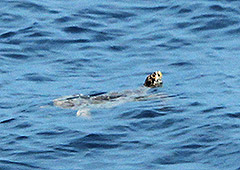
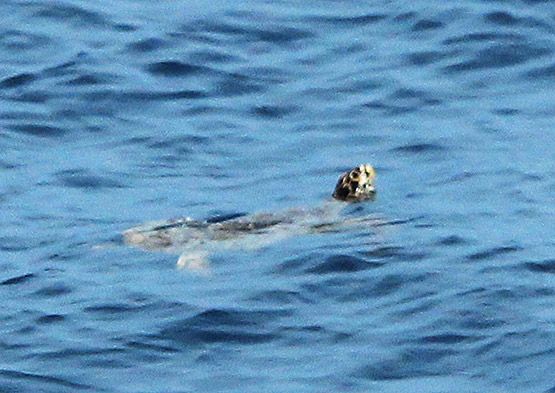 turtle swimming towards nesting beach
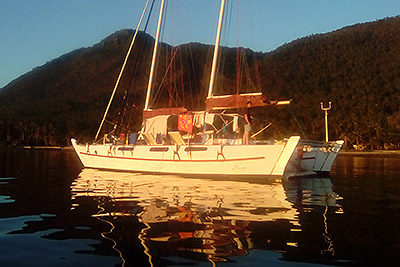 idyllic anchorage at Banton Island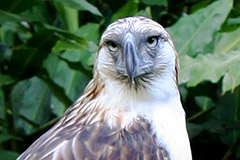
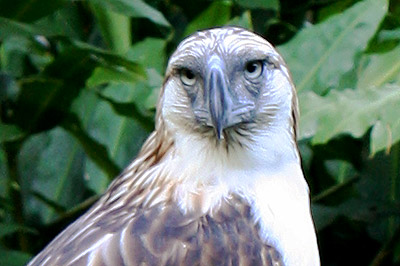 Philippine Eagle severely threatened by habitat loss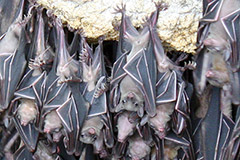
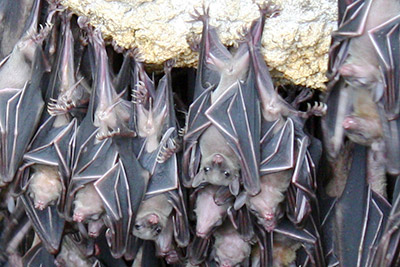 Fruit bats preparing for a night in the forest